







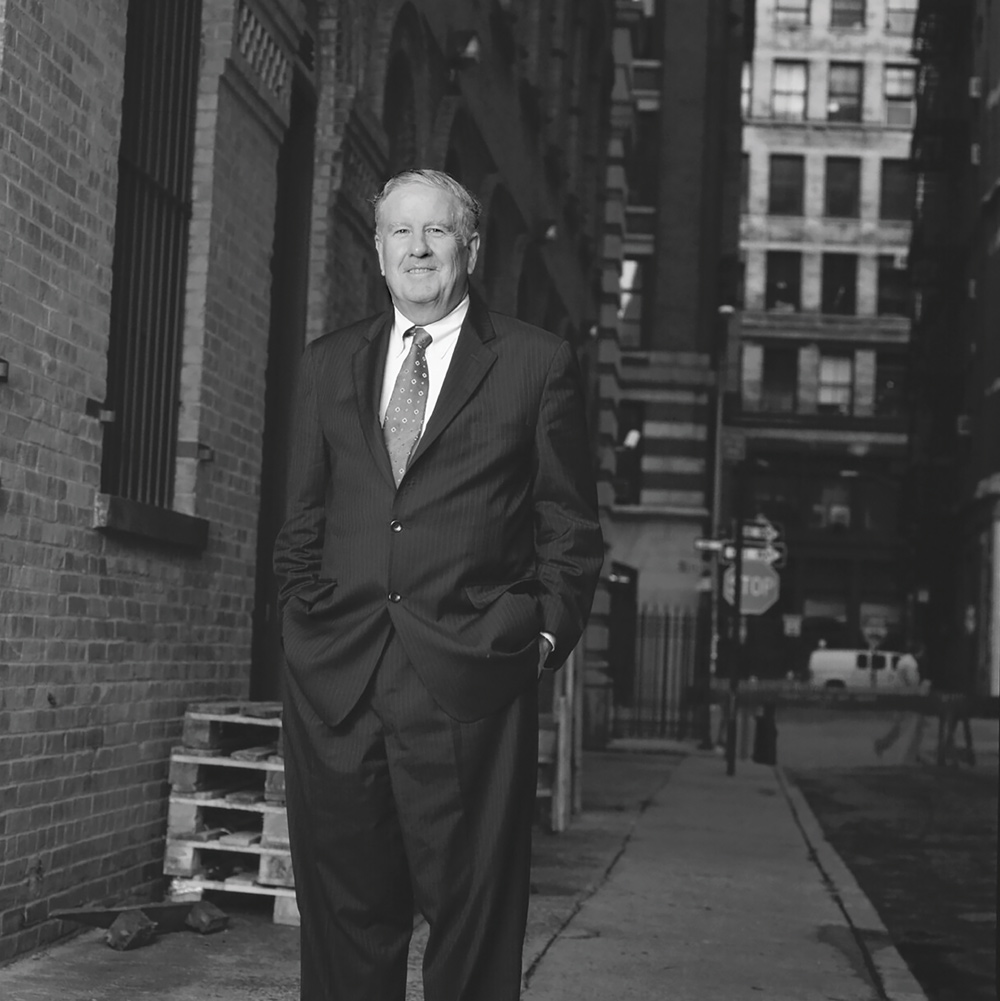
 As he weighed continuing in academia versus returning to private practice, he was asked by then mayor Michael Bloomberg to serve as a pro bono special master looking at homeless families’ access to shelter in New York City, in response to a lawsuit filed against the city by the Legal Aid Society. Feerick, then 66, spent three years as a special master, a role that changed his career. “I was deeply affected by meeting children who were homeless and their families,” he says.
“I was so incredibly touched and impressed with the work that he was doing as a special master that [I asked], ‘Do you think we could build a center around that?’” remembers Treanor, now dean emeritus of Georgetown Law and Fordham Law. “‘It combines social justice and finding ways to get people to work together, and nobody does it like you. We could build a great program, have an impact on society, and build a great educational program.’”
An innovative new center launches
2006, the John Feerick Center for Social Justice and Dispute Resolution was born. It opened with a skeleton staff and was housed in a satellite law school building next to the post office on West 60th Street. Feerick brought in Theodora “Dora” Galacatos ’96 JD as its senior counsel after working with her during his time as special master; Robert Reilly ’72, ’75 JD as assistant dean of the center; Professor Elizabeth Cooper as faculty director; and Derek Hackett as administrative assistant. He also reached out to Fern Schair, then senior vice president with the American Arbitration Association, and asked her to become the chairperson of the Center’s advisory board.
In October 2026, the Center—now known as the Feerick Center for Social Justice—will celebrate its 20th anniversary. Over the past two decades, it has become a leader in social justice work, launching signature programs that serve New York City and beyond, and also successfully advocating for legislative change in New York.
“We help those who are marginalized and people in need of help, where legal services can make a difference,” explains Feerick, who will turn 90 on July 12, 2026. He remains active at the Center, now housed on the 7th floor of the Law School building. He also co-teaches a course on professional responsibility and ethics in dispute resolution, along with Fordham Law’s Rule of Law Clinic.
When it first opened, one of the Center’s initial projects was developing a new way to handle disputes between the Catholic Bishops Conference and organized labor. Over the years, the Center has branched out into four core areas: education equity, immigrant justice, consumer defense, and co-administering the New York State Unified Court System’s Attorney Emeritus Program, which places senior volunteer lawyers with civil legal services organizations throughout the state.
Besides the Feerick Center’s staff, which remains lean with a handful of full-time employees, the Center harnesses law student volunteers, AmeriCorps VISTA members, and fellowship recipients to get its work done. “It is a very small group with a big footprint,” says Lisa Landau, who became the Center’s new executive director in November 2025 after a 35-year legal career working in civil rights, nonprofits, and health care law. Galacatos, who has received numerous awards for her work at the Center, continues as its senior program advisor.
Its staff and supporters say they have no doubt the Center will continue for at least another 20 years, with Landau at its helm for the next chapter and the addition of Dean Emeritus Matthew Diller, who became co–senior counsel at the Center in 2025. “I can use the skills I developed as dean to further the mission of the center,” says Diller. “I’ve seen an increase in students who want to roll up their sleeves and get involved.”

A new model for pro bono service
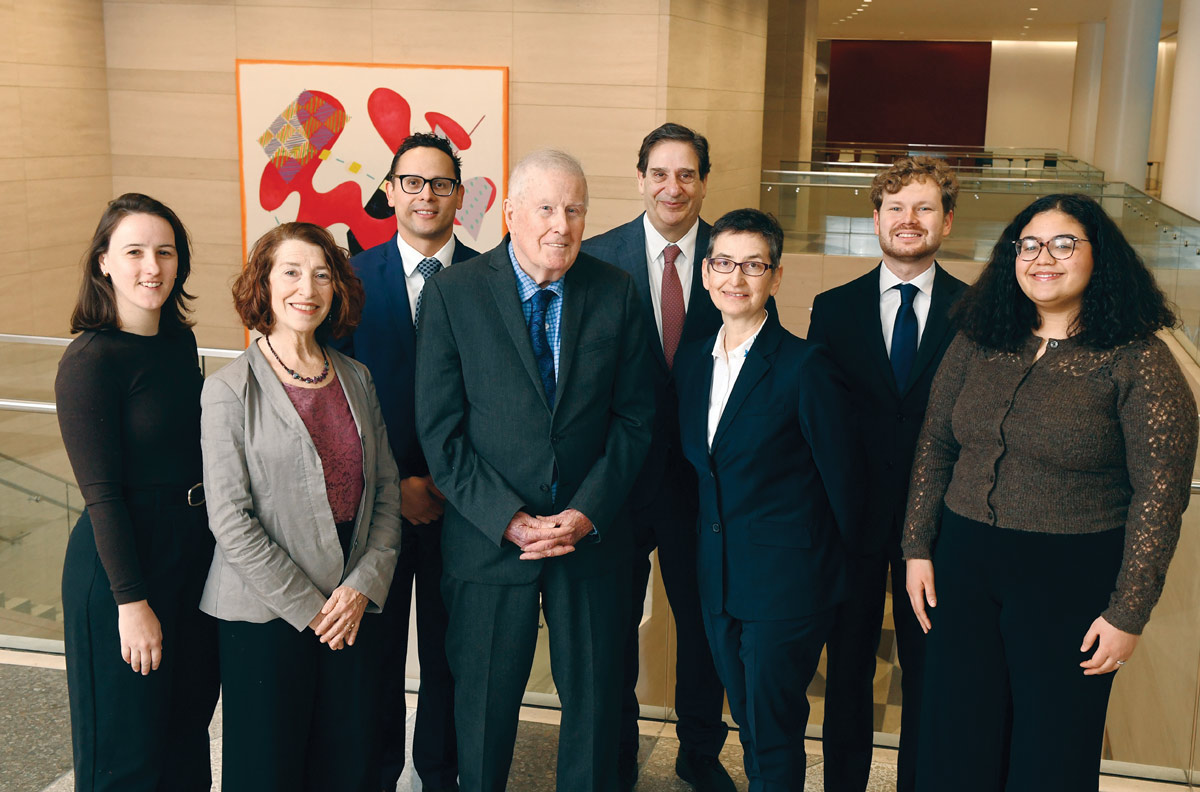
ne of the Center’s most well-known initiatives is its role with the Attorney Emeritus Program, run by the New York state courts and co-administered by the Center, which leverages the knowledge and skills of senior pro bono lawyers who help New Yorkers in need with civil legal problems.
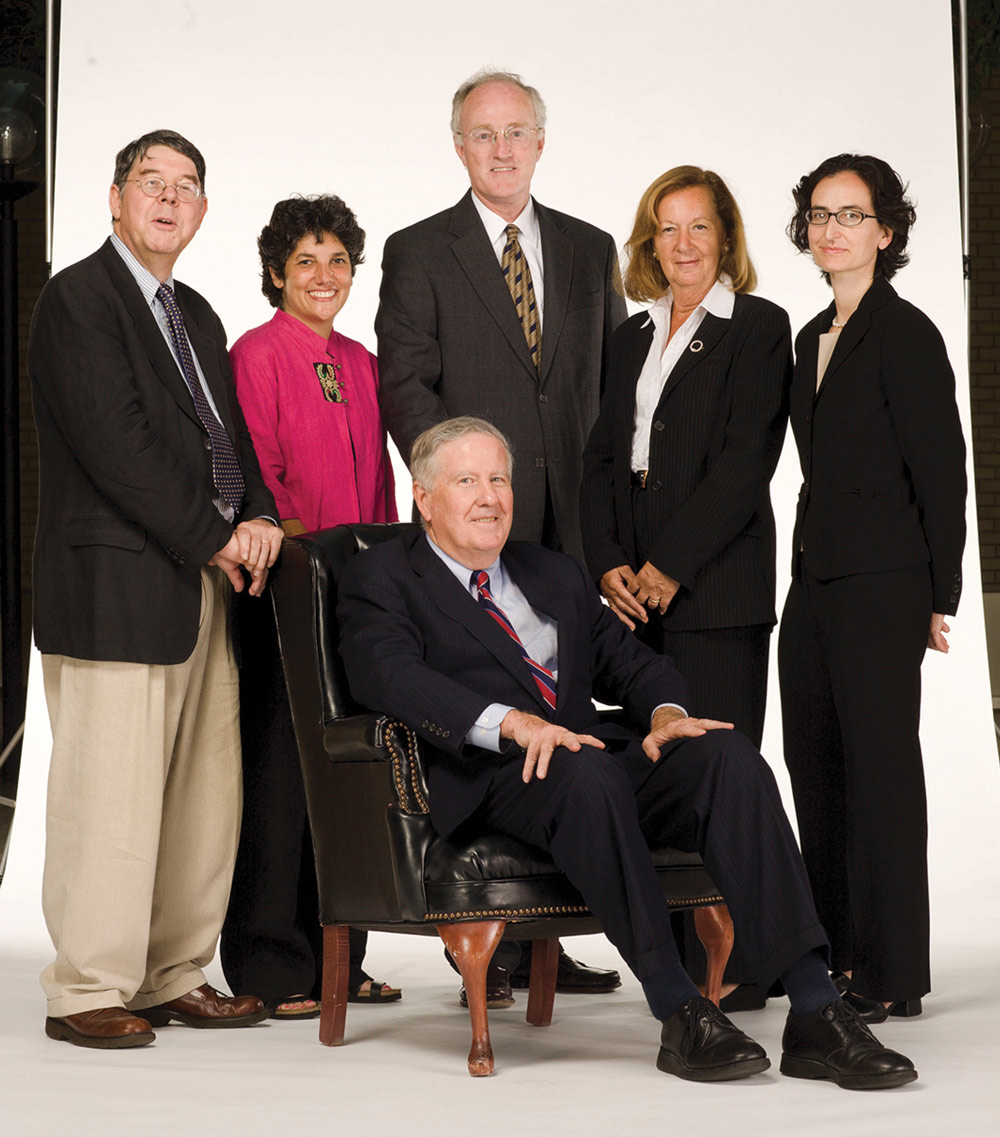
The program is part of the court system’s Office for Justice Initiatives. Christine M. Clark, associate justice of the appellate division in New York, serves as the judicial co-chair of the program’s advisory council, along with Feerick. “Attorneys that are still practicing and active and over the age of 55 can be involved in a legal community and use their expertise to become mentors to younger lawyers to help New Yorkers in need,” says Clark.
Since its inception in 2010, the program has grown from 40 to 2,060 attorneys. Participating attorneys are paired with partner organizations to help clients in numerous areas—disability cases, adoptive and foster family matters, services for the incarcerated, landlord/tenant issues, or consumer debt, to name a few. When the program celebrated its 15th year in November 2025, volunteers had contributed more than 125,000 pro bono hours and closed 15,000 legal matters.
Beth Schwartz, formerly a clinical law professor and former director of professional skills at Fordham Law, is one such lawyer. She has represented clients in matters of employment discrimination and civil rights violations. “I know that I’m making a difference,” says Schwartz of her involvement in the program. “It’s very satisfying to do this work.”
A path forward for people in debt
2007, the Feerick Center began assisting New Yorkers facing debt by starting the Domestic Violence and Consumer Law Working Group, which focused attention on the plight of survivors of domestic violence who were saddled with debt from their partners.
Initially, the Center brought together lawyers, staff members, and social service providers to improve policy and practice as it related to survivors. Later, it got involved in the Civil Legal Advice and Resource Office (CLARO) programs that provide limited-scope legal services for New Yorkers being sued for credit card debt.
When the Center opened in 2006, there were only two CLARO centers in the city, located in Brooklyn and Queens. After seeing how CLARO offices assisted clients, and hosting a conference on consumer debt in 2008, the Center joined with partners to expand the CLARO program.
By 2010, the Center had launched CLARO programs in Manhattan, the Bronx, and Staten Island. There, volunteer lawyers and experts explain the court process, review case files and prepare papers, and advise unrepresented litigants. “Since that time we’ve had the privilege to be a part of this really extraordinary community of advocates, service providers, and academics,” says Galacatos.
The Center also tackled an important aspect of the consumer debt problem. Cooper, her Legislative Advocacy Clinic, the Center, and others successfully collaborated to reduce the post-judgment interest rate on consumer debt in the state of New York from 9% to 2%, after New York Governor Kathy Hochul signed the Fair Consumer Judgement Interest Act in 2022. “This change updated a 40-year-old statute and radically improved thousands, if not hundreds of thousands, of lives across New York state, enabling so many of our neighbors to pay off unjustly burdensome debt and to move forward with their lives,” says Cooper.

Advocating for immigrant justice
he Feerick Center began working on a new issue—immigrant justice—in 2012, after Fordham alumna and adjunct professor Olga K. Byrne ’04 JD, now a director at the International Rescue Committee, spoke about the dangers facing unaccompanied migrant children at the southern border. The Center hosted a summit to learn more about the issue, and soon after, its staff secured two years’ worth of funding to support organizations helping those minors.
“We were not delivering services ourselves, but we could make a contribution and move the needle by bringing stakeholders together,” Galacatos says. In 2016, the Center pivoted and began working directly with asylum seekers in family detention, mostly women with minor children who had crossed the border.
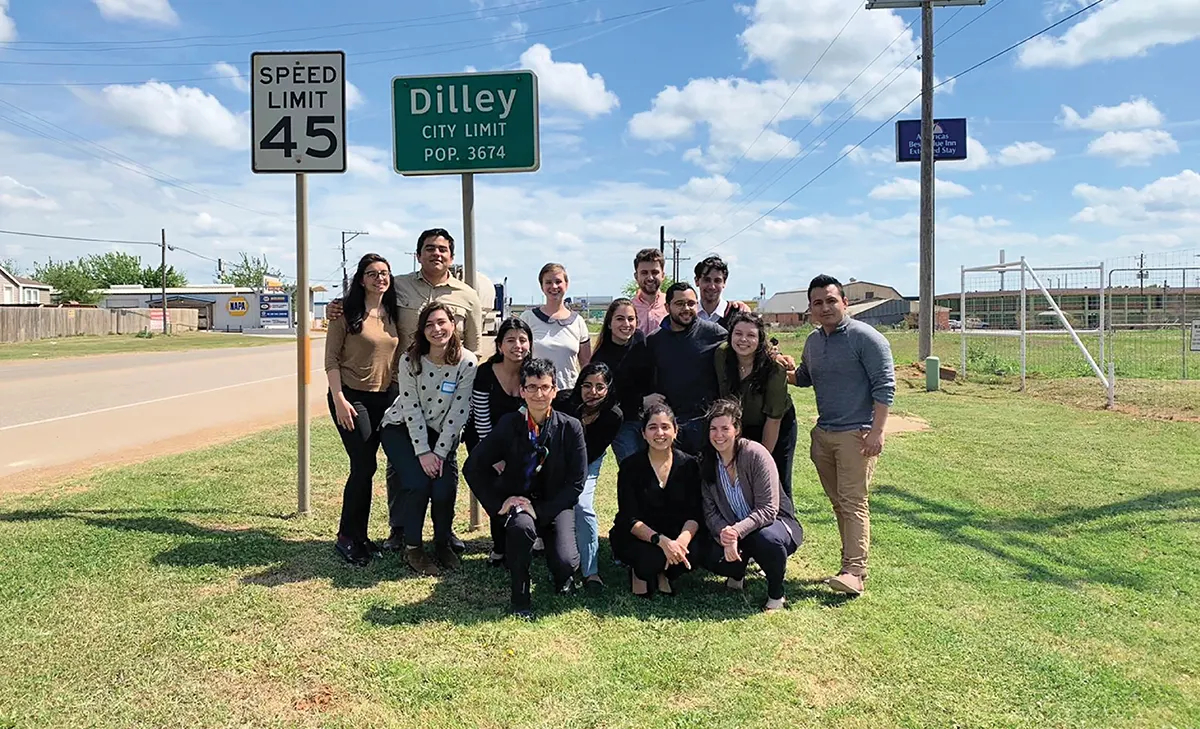
Working with an organization in Dilley, Texas, the Center brought volunteer lawyers and students to provide limited-scope legal services to detained immigrant clients, creating such a popular service trip that 319 students and volunteers made 34 trips to Texas from 2016 to 2020, helping 8,000 people. After the pandemic, the Center began assisting people in El Paso, Texas, helping 600 clients in the past three years. “In Dilley, we ended up being the institution that had the most volunteers,” says Galacatos. “Volunteers came, sometimes students, up to five trips a year, until the pandemic. We had 170 unique volunteers go down; many went multiple times. That was life-changing work for the volunteers.”
Law students who participated in Feerick Center’s work at the border say that their experiences opened doors for their legal careers. Emerson G. Argueta ’18 JD, who has served as associate director of the Center since 2023, says it was a trip to Dilley during his first year at Fordham Law that put him on the path of becoming an immigration attorney. “It was my first experience working with traumatized populations,” he recalls. “We were meeting folks after their initial arrival in the U.S., a few days after their apprehension by immigration authorities.” Argueta says his contacts at the Center helped him gain valuable summer internships and a job after graduation.
The enthusiasm of law students doing immigrant justice work also has spread to the larger Fordham community. When border states began busing migrants to New York City in 2023, the Center called for volunteers to help the migrants, and more than 400 students, faculty, and staff from Fordham answered the call.
Pursuing education equity
addition to addressing immigration justice and consumer debt, the Center got involved in improving the New York City high school application process in 2012 after receiving an AmeriCorps VISTA grant called the Legal Economic and Educational Advancement Project.
As the Center studied the high school application process, it concluded that the existing system made it difficult for underserved students—especially those with limited English—to have a fair chance at getting into competitive high schools. More than 70,000 eighth graders each year in New York City apply to high school through a complicated citywide application of ranked choices. The Center found that many selective “screened” high schools didn’t post online their rubrics for evaluating students, and that the admitting process was not unified. The Center held a conference in November 2016 to discuss equity concerns and efforts to help parents and students with the process.
In 2019, the Center published a report titled “Screened Out” about its findings, and as a result, the New York City Department of Education asked the High School Application Advisory Committee to make recommendations for making admissions more equitable. New York Appleseed, a nonprofit school advocacy organization in New York City, partnered with the Center on improving the application system. Nyah Berg, executive director of New York Appleseed, says the Center’s strong relationship with the public schools aided its success: “It wasn’t about pointing fingers or doing some sort of robust audit to get them in trouble. It was always about how we could improve the work being done and how we could be helpful and support each other.” Recommended changes included centralizing the application process and standardizing rubrics. This work continues. Last year, the Center held bimonthly meetings with the committee to bring interested parties together to continue to improve access for applicants.
Looking to the future
he looks to the next chapter of the Center, Feerick anticipates there will be other areas of service to explore. “I hope we never leave the area of helping people in need of legal services,” he says. “I hope we will always have, among other activities that might engage us, a commitment to helping the vulnerable and needy.”
He noted the years of work done by the Center would not have been possible without the generosity of its donors, including many Fordham Law alumni.
Feerick Center staff and partners say they’re proud of the Center’s two-decade record, but they’re not done yet.
The Center is launching a new national training program that brings together public interest lawyers and representatives from nonprofits for training courses and immersive workshops. Developed by Feerick Center Advisory Council member Kevin Curnin ’95 JD and Galacatos, the trainings are grounded in the principles of movement lawyering, community organizing, and anti-racism. According to Curnin, the initiative began with a fundamental question: “How do we train people in the principles and actions that animate this kind of lawyering so they contribute to structural change that helps to alleviate poverty, fight racism, and create equity?”
Galacatos agrees: “There’s always so much more than we can do. … Every single one of those programs has a lot of room to grow. There’s no dearth of opportunity to do good work; everywhere you turn in New York City or New York state there’s people of good will. Lawyers can make a difference, everywhere, all the time.”